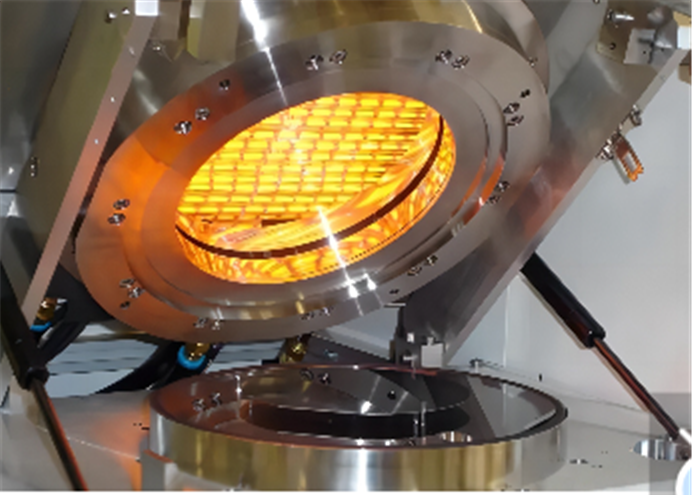
Out on the lithography floor, photoresist bake performance is what sets the tone for linewidth control. A 1°C drift in soft bake or hard bake shows up immediately as CD variation, and one particle is all it takes to kill a wafer. The TEL heater lamp was built to live with those realities, not fight them. What actually matters under the hood You get ±0.1°C temperature uniformity across the wafer, which keeps the thermal budget stable during photoresist processing. It’s designed to sit comfortably in Class 1–100 cleanrooms, and the engineering keeps outgassing and particle generation down. Repeatability isn’t a slogan—it’s baked in. Setpoints hold across lots, shifts, and as the tool ages. Short-wave infrared gives you fast, controllable heat-up, and the quartz components were chosen for thermal stability and chemical resistance. The payoff is bake profiles you can count on, run after run. Why it plays in high-volume fabs In volume production, the TEL heater lamp keeps photoresist bake inside spec, which means fewer linewidth excursions and less rework. Tight uniformity lets you keep process windows tight without bleeding yield, and the cleanroom-compatible build keeps particle counts low—critical on the layers that matter. It also supports stable thermal cycles, so performance stays predictable across multiple process nodes. For you, that translates into fewer line stops, lower scrap, and results that repeat from lot to lot. What you need to keep straight on the floor Installation comes down to matching the lamp to the exact tool interface and confirming airflow and thermal load are right. The lamp hits spec when the chamber and optics are maintained on schedule. After maintenance or a lamp swap, expect a short ramp-up to reach thermal equilibrium. Schedule calibration to hold that ±0.1°C uniformity and keep long-term repeatability in production.