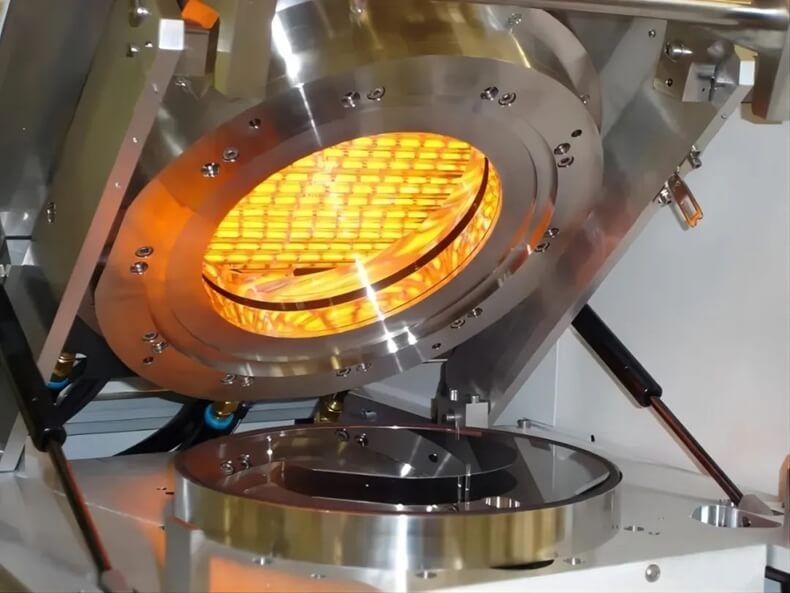
On the fab floor, polyimide curing isn’t just another thermal step. It’s a dimensional promise. Push or pull the temperature by even a few degrees across the wafer, and you’ll shift stress, warp the film, and watch yield drift out of spec. We built our approach around that reality: hold temperature where it counts, without giving up cleanliness or uptime. What matters, technically We pair a short-wave infrared emitter with a quartz-stabilized thermal field to hit wafer-level uniformity of ±0.1°C during the polyimide cure. Cycle-to-cycle repeatability comes in at ±0.2°C, so the numbers that matter—residual solvent, CTE—stay locked in. The chamber is cleanroom-ready, Class 1–100 compatible, with a particle-controlled path that keeps generation below 0.1 particle/cm² at 0.1 μm. The system sips power thanks to efficient conversion and fast thermal response, cutting idle draw without adding process time. Why this matters in the flow Polyimide curing sits right after photoresist processing and before lithography stacks. Thermal history here directly hits linewidth control and adhesion. With tight uniformity and repeatability, you see fewer rework lots and qualification windows that behave themselves. The payoff is film properties that land the same way across the wafer—less scrap, schedules you can trust. Reliability is baked in: components are rated for 24/7, and the thermal module holds output after 5,000+ hours with under 5% intensity drift. What you need to keep in mind Integration is straightforward on standard tracks, but the short-wave profile needs to be matched to the substrate stack and reflectivity. Gold-plated fixtures or highly reflective chucks can create localized overshoot unless the recipe is tuned. We supply the emitter, controller, and interface kit, but run a short qualification to lock in setpoints for your polyimide formulation and wafer size.